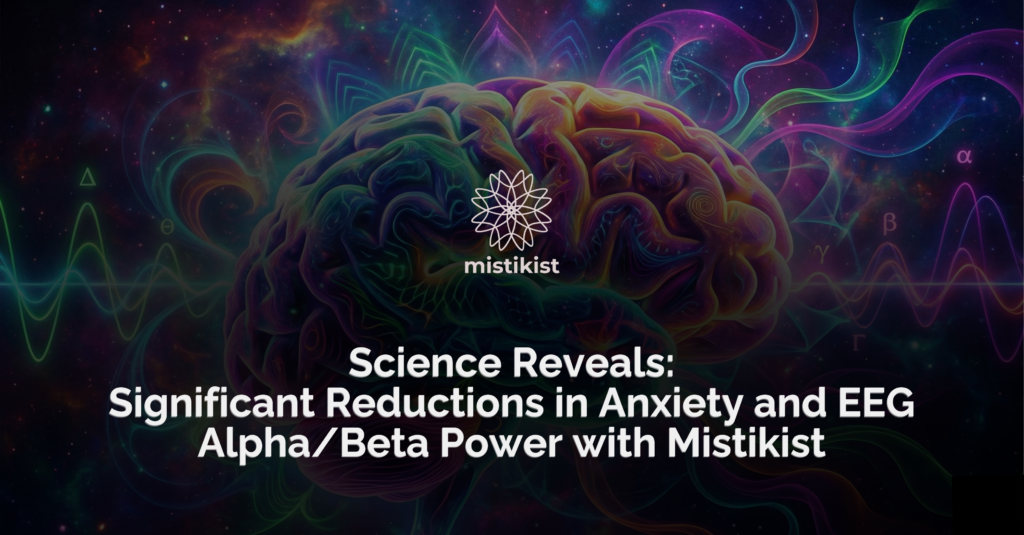
A rigorous prospective study published in Applied Psychophysiology and Biofeedback confirms the neurophysiological efficacy of AI-assisted Audio-Visual Stimulation.
In the rapidly evolving landscape of Digital Therapeutics (DTx), the demand for non-pharmacological interventions for anxiety is at an all-time high. However, the industry often faces a hurdle: the gap between “wellness claims” and “clinical data.”
A new study, Alpha and Beta Powers in EEG: How Audio-Visual Stimulation Influences Anxiety, has successfully bridged that gap for Mistikist. Conducted by researchers at Muğla Sıtkı Koçman University, this study utilizes 19-channel EEG (Electroencephalography) and standardized psychometric testing to quantify the impact of Mistikist’s Audio-Visual Stimulation (AVS) protocol.
Here is a breakdown of the data that validates Mistikist as a powerful tool for anxiety regulation.
Study Methodology
The study employed a randomized design with two cohorts:
- Subject Group (n=30): Received AVS via the Mistikist platform (Binaural beats transitioning 14Hz –> 7.83Hz + Green Kaleidoscopic Mandala visuals).
- Control Group (n=12): Exposed to Audio-Visual White Noise.
Findings
The clinical impact on anxiety was immediate and statistically profound. Using the State-Trait Anxiety Inventory (STAI), the study found:
- Mistikist Group: Pre-intervention median scores were 51. Post-intervention scores dropped to 26. This represents a statistically significant reduction..
- Control Group: Showed no statistically significant change, moving from 37.17 to 42.67.
Mistikist protocol demonstrated a clear therapeutic effect that outperformed placebo/control conditions.
The study went beyond subjective surveys, capturing the mechanism of action via EEG. Anxiety is often neurophysiologically characterized by synchronized, elevated activity in the Alpha (8-13 Hz) and Beta (13-30 Hz) bands.
Mistikist successfully desynchronized this activity, leading to a quieter, less anxious brain state.
- Alpha Power Reduction:Significant reductions were observed during stimulation across the frontal (F3, F7), parietal (P3, P4), and occipital (O1, O2) regions (p < 0.05).
- Data Point: At the P3 electrode, raw sum values dropped from 5.33 to 4.65 during the session.
- Beta Power Reduction: High-frequency Beta waves, associated with arousal and stress, were significantly suppressed during the Mistikist session
- Data Point: Temporal lobe (T3) Beta activity decreased from 5.26 (Pre) to 3.11 (During) (p < 0.001).
The Mechanism: Neural Desynchronization
The authors postulate that Mistikist works through neural desynchronization. The specific combination of binaural beats and optical stimulation disrupts the rigid, synchronized neuronal firing patterns typical of anxiety. By reducing this cortical noise in the Alpha and Beta bands, the brain shifts into a state of enhanced cognitive flexibility and reduced emotional load.
Conclusion
Mistikist is not merely a relaxation app; it is a validated neuro-technological intervention capable of producing measurable, significant physiological changes in the brain that directly correlate with reduced anxiety.
Resource
- Özdemir, İ., Tülay, E.E., Aksu, S. et al. Alpha and Beta Powers in EEG: How Audio-Visual Stimulation Influences Anxiety. Appl Psychophysiol Biofeedback (2025). https://doi.org/10.1007/s10484-025-09739-5